By Jack Penwell
Meow, meow, meow, meooooooooooow.
Stray, otherwise known as ‘that cyberpunk game you play as a cat in’, was originally released on the PlayStation family of consoles in 2022.
This release was met with critical acclaim for the atmosphere, narrative, cat mechanics and the visuals.
Now in 2026, it’s the Switch 2’s turn, and overall, it’s a very successful port.
Next Stop: Port Switch

Let’s jump straight into the main changes for the Switch 2 edition, namely, upgraded technical aspects and the addition of mouse controls.
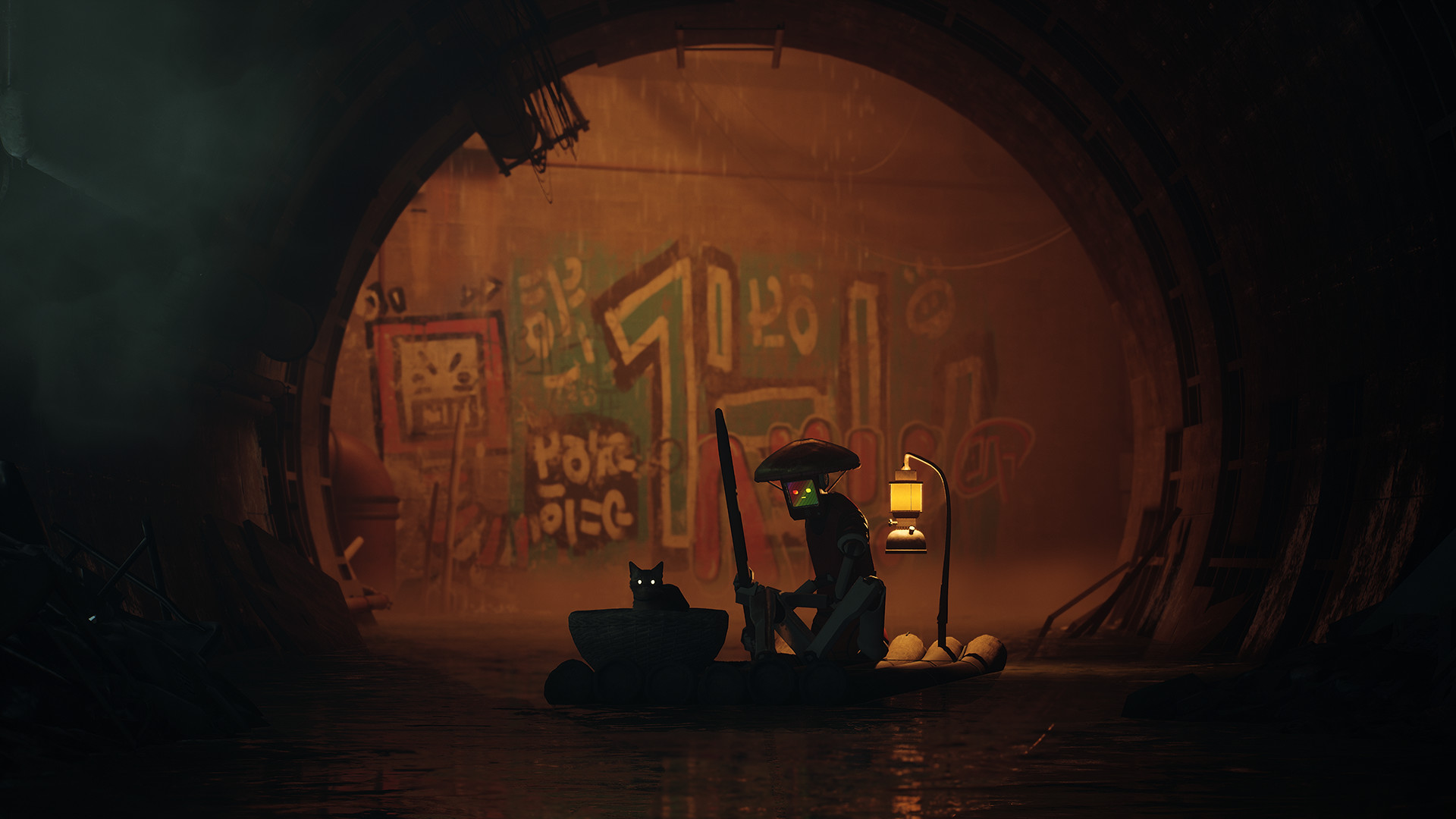
Overall, I had few issues with the technical aspects of Stray on Switch 2. The game honestly looks fantastic on both handheld and docked (where the game is 4K), with a handful of times where I had to look at my console to remind myself I wasn’t playing the PS5 version.
There are some visual sacrifices, of course, with some lack of shadows for certain objects and muddy visual details for both close-by and far-away objects.
The game successfully targets a locked 30 FPS, which is maintained generally throughout, although I did encounter stuttering a handful of times when a new level or biome is loaded or when there’s lots of artefacts on screen, namely plants or Zurks.
Another area to take note of, if you’re using the Switch 2’s handheld mode, is that the game does take a lot of power to run. I had about 2 hours of gameplay on a train before I ran out, so something to keep in mind if you’re travelling.
Mice! In A Cat Game?

Mouse controls, on the other hand, were less well implemented. They seemed to just always be on, with any time I wanted to change my grip on the Joy-Con 2 causing the camera to spin slightly.
While they can be used to change the camera, the left Joy-Con 2 is used to change the X axis and the right Joy-Con 2 is used to change the Y axis, so you need both in mouse mode at all times to use it, and even then, it’s clunky.
I would have loved a bit more focus on the haptic feedback instead, as it helps make some of the sounds, like scratching at the door, come alive. I would have loved it to be implemented for the purring of the cat as well, so you could feel even closer to your feline friend.
Feline Friendly

For those who are unfamiliar with Stray the game follows the titular unnamed cat, who, after a fleeting glimpse of the perfect cat life, falls into the depths of a cyberpunk city.
After rescuing a robot drone called B-12, you set off on an adventure to break through to the ‘Outside’, while helping a variety of colourful characters in robot form.
Actually, you are probably the most helpful cat I’ve ever seen, as most of the puzzles in the game revolve around you completing errands for the city folk, alongside some platforming and basic combat.
B-12 is instrumental in this as he acts as your translator to the robots, and while originally it felt like a bit of a gimmick to make it so you don’t have to work out the robots requests as a cat (the opening section where you don’t have this guide is fantastic in its environmental storytelling), you do end up feeling quite a bond to B-12 as he adds his own opinions to things.
The World – A Beautiful, Melancholic Creation

Overall, the setting is standard cyberpunk fair, with robots, corruption, high and low tech mixing and a lot of neon.
The world feels alive with lots of little animations and details from the inhabitants of the city and the ability to cause little issues as only a cat can, like tripping people up and knocking paint cans over.
I did also enjoy the little references in the game, as the robots were modelled after Marty McFly and Doc Brown in Back To The Future and a poet modelled after Bono from U2.
As a completely separate note that I feel I just have to mention: I would absolutely love BlueTwelve Studios to collaborate with Valve on a Half-Life game, as the vibes are just right there.
Platforming – Graceful As A Cat

Stray revolves around four main gameplay styles, of which I’ll discuss each in turn. Firstly, you’ve got the platforming sections.
These involve you figuring out a route from one area of the world to another, using your cat’s agility and lack of fear to leap onto tiny podiums and swing across light fixtures.
Now, the game doesn’t really allow you to ‘fail’ these sections, as the cat will refuse to jump if it can’t make the jump, so it’s less procession platforming like Mario and more a guided journey.
However, the little animations that happen periodically, with the cat scrambling up the side of the wall or bounding gracefully across multiple pipes, are a joy to behold, and I found it quite relaxing to just jump around the areas.
Open-World – Fetch Quests Galore

Next up, you have small open-world hub areas. In locations like The Slums and Antvillage, you are left to your own devices to slowly make your way through the puzzle box that is the world.
You’ll be interacting with robots, doing fetch quests, causing nuisances and solving problems to complete both main and side-quests to help the robots.
While these areas can seem overwhelming at first, especially after the mostly linear experiences in other areas of the game, I grew to love these environments and started to know my way around them by memory, especially The Slums.
If anything, the later stages don’t quite hit the same level of puzzle box as The Slums, with its multiple side-quests and main quests overlapping each other, but still, each one felt distinct.
Combat – Attack!!

Now, you might not have expected, or particularly wanted, combat in a game about a stray cat, but alas, we do get a little bit.
I say a little bit, as it’s self-contained to one section of the game, which, without spoiling too much, proceeds to disappear quite quickly.
In this section, you are given a Defluxor, which can incinerate the Zurks, tiny creatures that have evolved from trash-eating bacteria to animals that will eat anything.
However, the Defluxor can only be powered on for a few seconds before it overheats, causing you to have to just run around, waiting for it to recharge, before you can finish off the final few Zurks in the area.
Overall, it’s a clever enough idea to allow you to have some payback against the Zurks after they cause you such trouble in the opening section of the game, but overall, I would have preferred some more environmental attacks rather than just a point and shoot.
Stealth – Sight-Lines And Sentinels

Finally, we’ve got stealth, which replaces combat in the latter section of the game. With Zurks replaced by Sentinels, evil robot drones who can shoot lasers, you have no choice but to evade their sight lines and attacks.
This involves a bit of platforming, a bit of puzzle solving and a bit of, oh wait, they’ve found me, run!
It’s good fun, and thankfully you can turn off the ‘cat death’ animation if it gets a bit much.
Overall, Stray is a great little game. Clocking in at about 5 1/2 hours, with about 75% of the side activities done, it’s nicely paced, doesn’t overstay its welcome and is a mix of welcoming, graceful and slight difficulty to control. Just like a cat.
It’s difficult to give a score to a game such as this, as it very much depends on your affinity to the feline creature and your mileage, but if you like mostly linear adventure games with a hopeful message and light challenge, then check it out.
7.5/10
A Nintendo Switch 2 review code was provided by the publisher.
Leave a Reply