By Harry Penwell
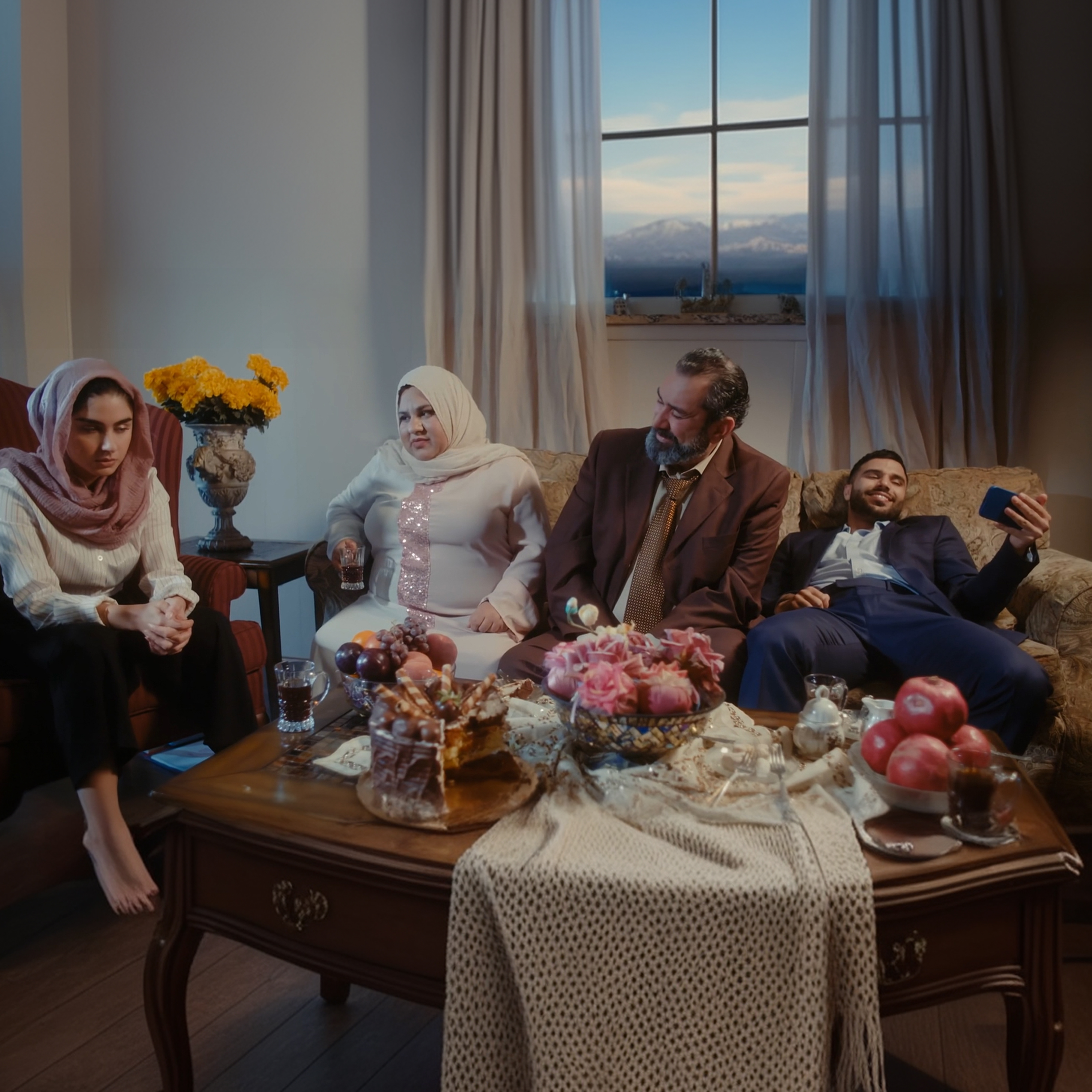
2016. Days before what would turn out to be a monumental election in the USA. A classic suburban street. And familial tensions over tradition vs new opportunities, cultures and politics are bubbling underneath…
See Inside the Houses

One of the best things about stories is their ability to show you lives, worlds and cultures that you otherwise wouldn’t know anything about. And one of the best things you can do as a cinephile (or TV, books, games fan etc.) is to explore narratives that you wouldn’t normally see, from/about people you don’t know much about. That’s also one of the best things about writing for a website such as this – I’m shown films such as Pomegranate.
All this to say that I don’t really know a lot about Iraqi-American culture, Iraqi-Christian culture or Iraqi-Muslim culture. But I think that I know a bit more after a surprisingly engaging 2-hours.
This includes the similarities between the characters’ lives and the lives closer to my own – from the purposefully irritating but loving sibling relationship to the contradicting need for independence and family.
And the differences, such as some of the specific rules, particularly around what women are allowed to do, as well as the food, rituals (for example, the incense), and the quirks of the language, such as calling your children the equivalent of ‘mum’ and ‘dad’.
It also goes further than just East vs West, with differences in culture between Iraqi-Christians and Iraqi-Muslims, as well as generations. And while I may have missed something, I’m pleased that it never felt like it was punching down.
Tonal Shift

However, where it struggled a bit more was with the tone.
There were points where it was really funny, with some laugh-out-loud moments, particularly with the brother and, to an extent, the mother. And a generous helping of cringe comedy, again with the mother, such as how she’s convinced the Obamas themselves sent the letter from the government.
And there were some great dramatic moments, such as with Mary’s mother’s illness, and Niran’s feminist ideals, as well as her pride and prejudice moment of believing herself too good for McDonald’s.
But then there are moments where I have no idea if I’m meant to be finding it funny, endearing, frustrating or genuinely horrifying.
Should I Be Laughing?
For example, Niran’s aunt goes through a disability check to see what additional benefits she can get. After stating that she can’t wash, dress or feed herself due to the pain in her legs, the government agent leaves. And the aunt instantly stands up, the pain being either completely false or at least a lot less than she’d made out.
Now, am I supposed to see this as a criticism of benefit fraudsters or the system that forces/encourages benefit fraud? Or is it simply a joke that I’m meant to tut to, smile and shake my head while being endeared to the aunt?
A side note about how poverty is portrayed in American (specifically the Northern states) vs British films/shows. I find it fascinating that working-class and poor Americans are still shown, often, to be in large houses whereas the British equivalent tends to be a box room (see That 70s Show and its British equivalent). I’ve no idea if it’s realistic, but it does mean that I have to rejig my expectations. Just an observation though – what have you seen?
Mothers and Villains
Then there’s the mother. I keep going back to her as she’s probably the closest thing to an antagonist and is certainly the driving force of the film. I’m going to preface this with the understanding that I know different cultures have different tolerances and that I can’t really pass judgement after one film.
But wow, was that a lot of physical violence. From throwing sandals (played for laughs) to slapping her son round the back of the head (sometimes lightly, sometimes less so) to full-on launching herself at Niran, only to be held back by her son. This last one is criticised, but in a bit of a ‘well, that’s mum’ kind of way.
Her beliefs regarding female freedom are also mostly massively conservative/traditionalist. But this is a film about liberalism vs conservatism, so the debates around arranged marriage, female employment, and some of the superstitions/traditions (depending on which side you fall on) are more balanced.
Though the moment where she debates the family going back to Iraq, or just sending her daughter back, due to the potential shame of Niran being seen alone with a boy, was terrifying. Shame is an awful, awful thing.
By the end it looks like the film is going to settle on the mother being a villain, only for the father to finally do something. That something, though, is to say that he’d rather go to prison than let his wife marry off his daughter. This seems to be a dramatic climax but is then played for laughs.
People are complicated, and families more so, but I would love to see a deeper exploration of the mother’s character. For example, she spends the majority of the runtime cooking or worrying about people starving – is this a trauma response to having starved in the past, or a love language, or a way to exert control in the only way she can? There’s a lot more to unpack.
Performances, Chemistry and Slow-Motion

The acting is somewhat uneven, but none of it is unwatchable, and all of it is earnest.
The score was solid, the production design is great, and the little moments of non-naturalism (particularly the Democrat and Republican logos coming to life) were fun.
I’m not convinced by the strange slow-motion that occurred at certain points – I think it was meant to show either being lost in your daydreams or romance, but it came across as closer to a music video or the set-up for an 80s sex scene.
The rest of the camerawork is pretty good, though the extreme close-up at the beginning was a bit much! The car rides are great, though – especially in a world where they’re often just green-screened – as are the aerial shots.
The chemistry was all terrific, and the script is mostly great, with the stumbles feeling purposeful due to language barriers rather than as a result of iffy dialogue. And the screenplay mostly works, and it covers an awful lot in a 2-hour runtime.
That being said, the cruise competition scam section was odd! The scene where they almost give away their information to the scammer was good (it had me looking between my fingers at times), but the second phone call from the scammer’s male accomplice was out of place.
Election Stories

Knowing the results of the 2016 election means that the lead-up to it is fraught with awkward tension – it reminded me how unlikely the last 10 years felt (bearing in mind that I was only 16-17 at the time).
And, much like how Civil War was marketed (though I stand by that it’s a journalism movie, not one about politics), this seemed to be an exploration of the divides in modern-day America. But, really, the policies of Trump and Clinton, and why people might vote for them, are pushed aside as we question whether we can be neighbours with people of differing political opinions.
This is a shame, but I can’t really criticise the film for it as it’s just not what it set out to do.
However, I’d love a sequel set in 2020 and then again in 2024 and possibly in 2026. The world has changed a lot, and frequently, and seeing if the friendships and familial bonds, already strained, managed to survive would be fascinating.
Even more short-term, the film deals with the debate around the hijab, and what it represents – should women be forced to wear it, be forced not to wear it, or should it be a choice? While most of the film debates this in a balanced way, the ending comes to a particular decision which I’d love to see the other characters’ reactions to.
Conclusion
Overall, it’s a difficult film to rate by itself. For one thing, I can’t judge all of the cultural aspects without seeing more films (recommendations in the comments, please!) or learning more about the cultures. And while I don’t know the budget, I’m going to go ahead and say that it’s low.
This makes me more willing to overlook some of the clunkier aspects of the filmmaking. As does the fact that I was completely absorbed for the 2 hours.
But I need more – and perhaps that’s the biggest compliment and criticism I can give.
7/10
And that’s all! Have you seen Pomegranate? What do you think of the film? Let me know in the comments, and find the other adventures on DownUpJourney here. And be sure to check out my other writing here and more of my film reviews on Letterboxd!
A digital copy of the film was provided by the distributor.
Leave a Reply